Customer contact
AI receptionists and call handling
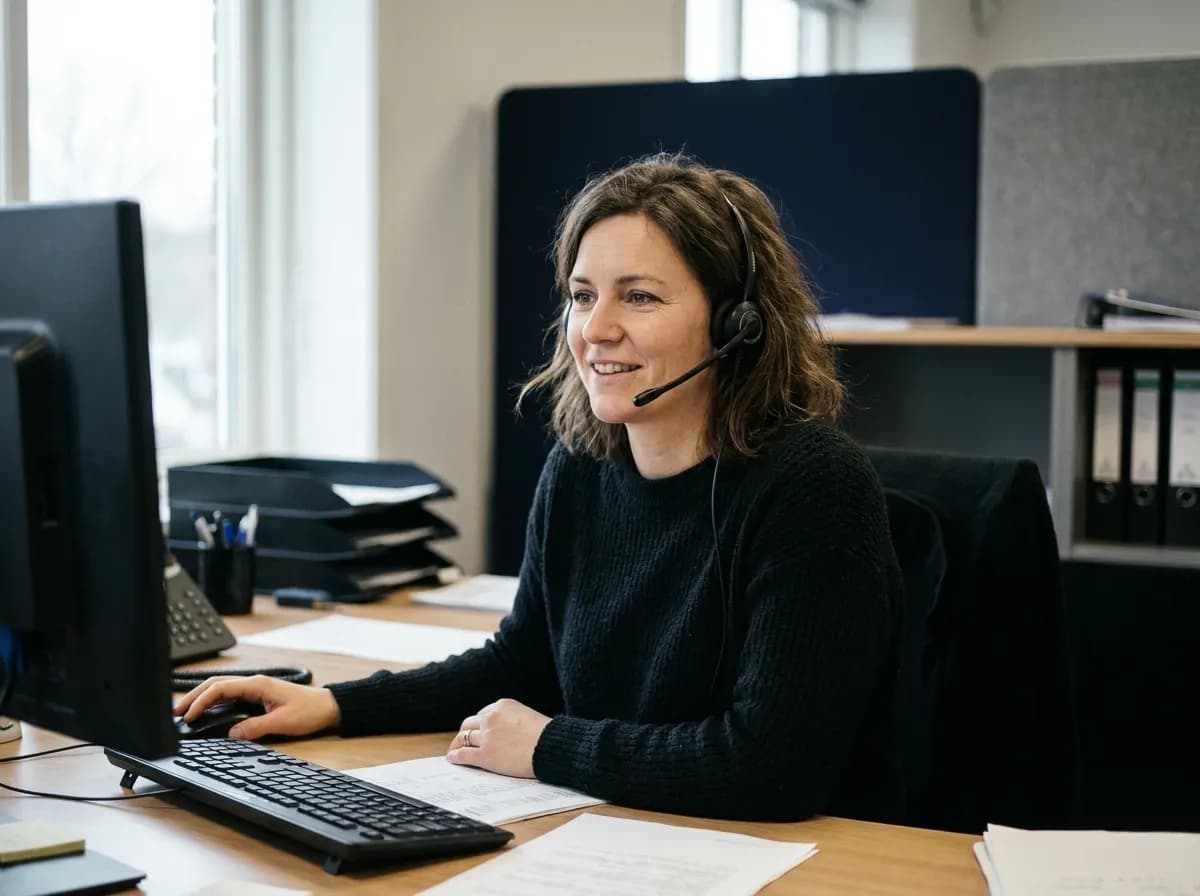
Calls go unanswered after hours or when every line is busy.
The problem
Why it happens.
Calls do not arrive evenly. They bunch up first thing, over lunch and in the early evening, which are the same times the people who answer them are busy, on a break or gone home. Staffing a phone for every peak costs more than most small businesses can justify, so the gaps are left to voicemail.
Voicemail does not close the gap. Many callers will not leave a message, and the ones who do still wait for a callback while they ring the next business on the list. The cost is hard to see because a missed call leaves little trace, so it rarely shows up in a report until someone compares the calls the phone system logged with the enquiries that were written down.
Signs you have this problem
- Voicemail fills up overnight and the first hour of the morning goes on callbacks.
- Callers ring off when they hear the queue or the answerphone.
- Engineers or practitioners take calls on the job and lose the thread of what they were doing.
- Messages are scribbled on paper and some never reach the right person.
- You only hear about a missed enquiry when the customer says they went elsewhere.
The answer
In plain terms.
Most missed calls happen at predictable times: before the office opens, over lunch, after 5pm and whenever two people ring at once. An AI receptionist covers those gaps. It holds a spoken conversation, takes the caller’s details, answers the questions you have written answers for, books within your rules and passes the call to a person when the conversation needs one. Echo One is the platform we build these agents on.
What changes
Every call is answered and logged, at any hour.
How it works
- 01
Listen to the calls you get today
We go through the reasons people ring, the questions they ask and what a good outcome looks like for each type of call.
- 02
Write the script and the rules
Greeting, questions, answers, what the agent may book, and the point at which it must hand over to a person. You approve every line.
- 03
Connect the phone, diary and CRM
The agent answers on your number, offers slots from your real calendar and writes each call’s transcript and outcome to your CRM.
- 04
Test with real call types
We ring it the way your customers would, including awkward cases, and adjust the script until it behaves as agreed.
- 05
Go live and review
Calls are reviewed after launch and the script is tightened where callers got stuck or a handover came too late.
A typical rollout
From first call to live.
Timings are a rough guide. They depend on your systems, your availability and what the discovery work finds.
- 01 · First week or so
Discovery and script
We review your call types, agree what a good outcome looks like for each and write the script and handover rules for you to approve.
- 02 · The week after
Build and connect
The agent is set up in Echo One, connected to your number, calendar and CRM, and given the voice and tone you have chosen.
- 03 · Towards the end of the first month
Test and soft launch
We test with real call types, then switch the agent on for a limited window, such as evenings only, while your team checks the results.
- 04 · Ongoing after launch
Full cover and tuning
Cover is widened to the hours you agreed, and call reviews feed changes to the script wherever callers got stuck.
What you get
- A configured voice agent answering on your number
- A written call script and handover rules you have signed off
- Bookings made into your calendar within the limits you set
- A transcript and outcome for every call, saved to your CRM
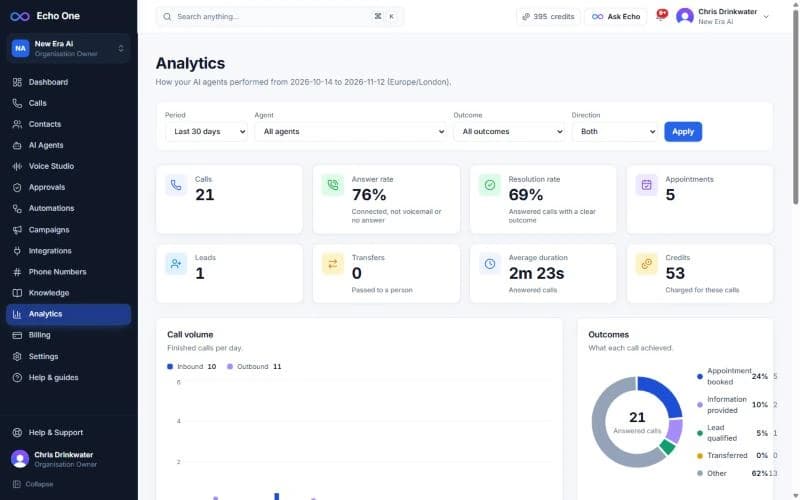
- Call analytics in Echo One showing what each call achieved
What it connects to
- Phone system or business number
- Calendar and booking tools
- CRM
- Email and SMS notifications
Who it suits
- Trades and home services that miss calls while on a job
- Clinics and appointment businesses with routine booking calls
- Offices that close at 5pm but take enquiries in the evening
- Businesses with several sites that want one standard of answer
A typical example
How it plays out.
A plumbing firm’s engineers are on jobs all day and the office closes at five. A customer rings at seven in the evening about a leaking tap. The AI receptionist answers, asks what the problem is, where they are and when they are free, then books a morning slot from the engineer’s calendar. The caller is told the booking is made, and the job, the transcript and the booking are waiting in the CRM when the office opens.
A generic scenario to show how the work runs. It does not describe a specific client.
Measuring it
How you know it is working.
- Calls answered against calls received
- The starting problem was unanswered calls, so this is the first thing to watch. Your phone system and Echo One both record it.
- What each call achieved
- A call answered with no outcome is half a job. Tracking bookings, captured enquiries and handovers shows whether the agent is doing useful work.
- Handovers, and when they happened
- Too few can mean the agent is holding on to calls it should pass on. Too many can mean the script needs more approved answers.
- Where callers got stuck or rang off
- Transcripts show the exact point a conversation went wrong, which tells you which line of the script to change.
- Enquiries taken out of hours
- These are the calls most likely to have been lost before. Counting them shows what the extra cover is bringing in.
Risks and safeguards
What could go wrong, and what stops it.
Risk
The agent gives a wrong or unapproved answer.
Safeguard
It works only from the script and answers you have approved, and it is tested against awkward questions before launch. Anything outside that becomes a handover.
Risk
A caller with an urgent or sensitive problem is kept talking to AI.
Safeguard
Handover rules name the situations that send a call straight to a person or to an urgent callback, and those rules are the first thing we test.
Risk
The diary is overbooked or booked wrongly.
Safeguard
The agent books only the appointment types, times and places you allow, from your live calendar. Everything else becomes a callback request.
Risk
Call data is stored without care.
Safeguard
Callers are told they are speaking to AI. Under UK GDPR you remain responsible for call data, so we agree what is recorded, where it is saved, who can see it and how long it is kept.
Questions
What people ask about this.
Will callers know they are speaking to AI?
We recommend the agent says so at the start of the call. Callers then know what they are dealing with, and anyone who would prefer a person can ask for one.
What happens with a call the agent cannot handle?
It passes the call to a person, or takes details for a callback if nobody is available. The handover rules are written and agreed before the agent goes live.
Can it make calls as well as answer them?
Yes. Echo One handles outbound calls such as reminders and following up older enquiries, with each call logged in the same way.
Can it answer on our existing number?
Usually, yes. Calls can be routed to the agent at set times, such as after hours or when every line is busy, or it can answer every call first. We agree the routing with you before go-live.
What can it book, and what can it not?
It books only the appointment types, times and locations you allow, from your live calendar. Anything outside those limits becomes a callback request or a handover, so the diary stays under your control.
How are transcripts and call data handled?
Transcripts and outcomes are saved to your CRM so your team can see what was said. We agree with you what is stored, who can see it and how long it is kept, and callers are told at the start that the call is handled by AI.
Read the detail
Next step
Start with the free AI Opportunity Assessment.
A short, no-obligation conversation about where your business is losing enquiries, hours and revenue. You do not need to choose a package first, and whatever we find carries straight into your audit, so your first paid day starts from evidence.